
Dear Abby,
Today, I cried in the cafeteria. Actually, it began just outside the financial aid office when I learned the loan I applied for hadn't quite been processed yet, or some such bollocks. I felt it oncoming as I put my hand on the doorknob in the staircase that brought me from the library where I was incessantly pestered by an odd couple discussing ancient mythology and tapeworms (not in the same sentence), and a very bizarre looking person who out of nowhere whispered, "She's ugly." So after being thoroughly disturbed from writing my philosophy paper and grasping at straws over what abstract concepts I was in vain attempting to articulate, I ended up in the financial aid office.
If you've ever had to go to such a bureaucratic corner of the universe, you would be familiar with how strikingly obvious the distinction is between the unfriendly cubicle matrons and the hoards of people trying to disguise their poverty with flashy knock-offs from discount stores. It is rather humiliating to have to be circumlocutious about your very real problems in such an aid office. In my experience, such an honest, humble revelation rarely gets a Have-not such as myself anywhere.
Although, I was very tempted to lose myself in that office, standing at a chest-high desktop having this mean meritocratic woman tell me now after three weeks that it's only her job to hand in the form even though she was aware the last time I spoke with her that I might not be eligible for further loans (that I'm willing, qualified, and need to take) and didn't mention it in the first place.
I then took the $75 that Mike loaned me for my Philosophy textbook to the bookstore where I was told they got rid of all the used copies and in order to buy a new one (usable only for another three weeks), I would have to pay $120.
With all this on my mind, I started to break down. I managed to pull myself together after a moment on the bench, and I figured that I could at least buy myself lunch.
I was very aware of how ridiculous I appeared, crying in the cafeteria while downing half of a deli sandwich and a box of chocolate Silk. I wished I could stop myself, and all I could think of while I was crying and eating my first real meal of the day was how stupid I looked and how I'd have to hurry up and finish eating so I could get to my class on time.
Somehow, I managed to drag myself to class, but I can't help but wonder why the hell I have to spend $120 on a textbook when there are ample textbooks that would adequately cover the same materials and not cost more than $35.
Maybe I do need medication...
But the tea party clowns might eat me (for being a welfare child).
Just some thoughts for today.
Tuesday, April 27, 2010


Wednesday, April 21, 2010
Committed to Free Will
I recently watched The Soloist , and it really expanded my view to the homeless. Subcity, by Tracy Chapman also illustrates a good point toward the homeless:
"They say we've fallen through the cracks
They say the system works
But we won't let it
Help
I guess they never stop to think
We might not just want handouts
But a way to make an honest living
Living this ain't living"
The first assumption most people have towards the broken is that they want to be fixed. It is natural to want to help disadvantaged people; however, no matter how unbroken we may seem in comparison, it does not give us the right to tell another person what is best for them. For example, if someone told you that your religious beliefs were entirely irrational, leads to violent and unstable behavior, causes conflict and degradation of other human beings; therefore, We in our Right minds are obligated to make sure you take this medicine. If you do what we tell you, you'll be like us, you'll be better. Your life will be much improved to the barbaric ways and ideals you've adopted.
Of course, that sounds rather radical, doesn't it? "Healthy" society often dictates what is proper and improper for mentally unhealthy individuals, tell us how to behave, coerce us (sometimes against our will) to imitate healthy society, or to go against our own judgments. Often, we are expected to act against behavior that might, in fact, be good for us.
For example, it would seem on paper that allowing a mentally unwell person to engage in behavior that would encourage poor distinction between fantasy and reality (such as roleplaying games). Allowing a person with clinical depression, fairly severe anxiety, and complex personality quirks (such as trust issues) to throw themselves into roleplaying games, writing, or reading might appear like enabling addictive or isolating behavior... on paper. However, gaming requires a comfortable amount of healthy social interaction, but where it really *sings* to help the clinically depressed is engaging higher intellectual thought processes with imagination. I have personally seen how roleplaying games help a handful of people who are clinically depressed, and over a matter of years, such a hobby provides more than just a distraction.
Well-meaning individuals would assume a regular schedule imitating "healthy" society would be the best medicine for steering the clinically depressed towards positive behavior. Many people would assume getting up early in the morning, a strict exercise routine, regular meals, set sleep schedule, etc. would be ideal therapy for the clinically depressed, but I strictly believe imitating a healthy schedule only serves to exaggerate how mentally unwell I am. While others seem to cope to such a schedule well, I feel more alienated by it.
Now, I'm not saying the clinically depressed should enable their own illnesses to rule their lives, but there is a delicate process involved-- a balancing act, if you will-- between working with depressive symptoms and finding the right schedule and activities that actually do help the individual person.
Roleplaying games offer one scheduled activity that a clinically depressive person can engage in like the typical poker night, but it is better than the typical social activity because of the research involved. RPGs have plenty of research involved that enables a person to dedicate attention and imagination to between scheduled gaming sessions. RPGs engage technical and critical thinking, imagination, storytelling and reasoning skills as well as provide a comfortable social activity. Close-knit gaming groups encourage forming healthy social relationships with others, which feeds back into the benefit of RPGs to the mentally unwell because gaming sessions become "socially safe" environments, where fellow gamers are unlikely to judge and micromanage another person.
A part of having a mental illness is that it interferes with your life, and a huge aspect of learning to manage one's illness to improve one's own quality of life is learning what works for the individual. This process cannot and should not be micromanaged, because there is no "one" path to wellness, and micromanaging a mentally unwell person strips them of understanding the illness and separating symptoms of the illness with one's personality traits-- with who they are as a person foremost. The reason why it is morally wrong for anyone to micromanage or coerce a mentally unwell person into another's understanding of the illness and treatment is that it robs the unwell person of their freewill. Not only is it almost impossible for an unwell person to fight the illness for the approval or requirements of another, this gives a false sense of wellness for the individual sufferer. It robs them not only of their understanding, but interrupts and distracts from the individual's own progress. A shattered sense of trust can not only interrupt and distract from this progress, but encourages isolation and unhealthy behavior.
Most mentally ill persons are not a danger to themselves or others. Speaking with personal experience, there is a great amount of trust involved in taking an unknown mind altering substance at the request of a stranger, who may or may not have your best interests in mind. Such a concept may sound paranoid, but it is still true. Even well-meaning doctors find it hard to accept they are morally obligated to fully explain medications and therapy to their patients under the mindset of "Well, they want to get better, don't they?".
Wanting to be "well" is different from being able to trust others. Wanting to be "well" is a complex issue for the mentally ill. Fear of drug-related illness, flat affect, and prejudice is overwhelming (at least for myself).
Despite the advances in humane care for the mentally ill, prejudice and wrongdoing still exist. Doctors at understaffed and severely overbooked clinics might not be as dedicated to finding what's best for a patient, and are often unable to take the time to get to know a patient's needs if that patient cannot communicate them effectively. Not to mention, there is a long-standing history of abuses towards the mentally ill. Many people, even some of the mentally ill themselves, are poisoned by the idea that a desire to do better or fight off "less severe" illnesses (such as clinical depression and anxiety/phobias versus schizophrenia and bipolar disorder) is all it takes to enable and empower a mentally ill person to get on the road to recovery.
Fighting off depression is like fighting off an addiction to cocaine, or severe alcoholism; except there is no set "trigger behavior" to steer a depressed person off the path of "wellness". Depressive persons who happen to fall into certain misfortunate socioeconomic classes also have the burden of poverty. "Getting better" requires a vast change in lifestyle for a poverty-stricken depressive. Often therapy and medication is required, and how can anyone expect a person to go through rigorous paperwork (to get assistance), the struggle to get back and forth between doctor's appointments (especially if homeless, without transportation, or with a job where you might be fired or have your hours reduced by taking necessary time off, regardless of what the Americans with Disabilities Act declares). The lowest paying jobs are often surrounded by immoral and illegal acts, and since the poor are not likely to be in the position to sue an employer (much less get a job after suing an employer), these acts go under the radar and unregulated.
Things get more complicated if that depressive person is a single mother, who has children to care for.
As a good friend of mine pointed out, "And never forget the price tag on those medications. Provided they eventually find one that doesn't make you worse, or give you a new condition, or turn you into a completely different person (that one most likely when the patient is an introvert, as many of the anti-depressants 'fix you' by massively increasing extroversion, even if unnatural for... See More the patient), there is the perpetual terror that then, you will be forced to choose between your medicine...and food.
You can't always predict the direction that choice is going to go, either."
I agree entirely. More often than not, government or organizational assistance does not cover psychiatrist visits (rather leaving it to clinic physicians). More often than not, assistance programs covering prescriptions only cover a select number of medications, and might not cover the medicine an individual would prefer. Giving the mentally ill in poverty access to good care (rather than basic care), where an individual can select professionals not desperately overburdened by an overpopulated clinic, take the time to get to know and trust a professional, gain the tools necessary to understand one's illness and the full range of treatment options, and gain affordable access to a wider range of treatment options might actually break the cycle of depression and poverty. But the key really comes from the individual's understanding, willingness, and free will.
Having a mental illness already takes away certain freedom of choice, and no one wants to be forced or coerced into a way of life that isn't right for them. No one has the right to tell another person how to live.
The answer isn't as simple as asking for help.
Many mentally ill people refuse to take medication NOT because they don't know it will "make them better", but because it doesn't actually help improve their lives or fear of radical behavioral modification, abuses or oversights by medical professionals, etc.
No one has the right to tell another human being they must live a certain way. Copying the behavior of "healthy" people does not improve the mental health of "unhealthy" people.
Bipolar disorder or depression alone are common ailments of artists. As an artist, I firmly believe some of the chemical imbalances in my brain are good for some functions, such as giving a range of perception and insight to the physical, political, and spiritual world around me. It does "expand my mind", and if I were to take the wrong medication, I fear trading one set of familiar symptoms with a new set of foreign ones. I also fear flat affect, but most of all I fear getting worse.
I have experienced what it is like to have a medication make a person want to commit suicide and self-harm. I know it is a different experience than my lowest of lows.
I also know it is wrong for people to tell me I don't know what I am clearly aware and informed of, that I don't know what's best for me.
, and it really expanded my view to the homeless. Subcity, by Tracy Chapman also illustrates a good point toward the homeless:"They say we've fallen through the cracks
They say the system works
But we won't let it
Help
I guess they never stop to think
We might not just want handouts
But a way to make an honest living
Living this ain't living"
The first assumption most people have towards the broken is that they want to be fixed. It is natural to want to help disadvantaged people; however, no matter how unbroken we may seem in comparison, it does not give us the right to tell another person what is best for them. For example, if someone told you that your religious beliefs were entirely irrational, leads to violent and unstable behavior, causes conflict and degradation of other human beings; therefore, We in our Right minds are obligated to make sure you take this medicine. If you do what we tell you, you'll be like us, you'll be better. Your life will be much improved to the barbaric ways and ideals you've adopted.
Of course, that sounds rather radical, doesn't it? "Healthy" society often dictates what is proper and improper for mentally unhealthy individuals, tell us how to behave, coerce us (sometimes against our will) to imitate healthy society, or to go against our own judgments. Often, we are expected to act against behavior that might, in fact, be good for us.
For example, it would seem on paper that allowing a mentally unwell person to engage in behavior that would encourage poor distinction between fantasy and reality (such as roleplaying games). Allowing a person with clinical depression, fairly severe anxiety, and complex personality quirks (such as trust issues) to throw themselves into roleplaying games, writing, or reading might appear like enabling addictive or isolating behavior... on paper. However, gaming requires a comfortable amount of healthy social interaction, but where it really *sings* to help the clinically depressed is engaging higher intellectual thought processes with imagination. I have personally seen how roleplaying games help a handful of people who are clinically depressed, and over a matter of years, such a hobby provides more than just a distraction.
Well-meaning individuals would assume a regular schedule imitating "healthy" society would be the best medicine for steering the clinically depressed towards positive behavior. Many people would assume getting up early in the morning, a strict exercise routine, regular meals, set sleep schedule, etc. would be ideal therapy for the clinically depressed, but I strictly believe imitating a healthy schedule only serves to exaggerate how mentally unwell I am. While others seem to cope to such a schedule well, I feel more alienated by it.
Now, I'm not saying the clinically depressed should enable their own illnesses to rule their lives, but there is a delicate process involved-- a balancing act, if you will-- between working with depressive symptoms and finding the right schedule and activities that actually do help the individual person.
Roleplaying games offer one scheduled activity that a clinically depressive person can engage in like the typical poker night, but it is better than the typical social activity because of the research involved. RPGs have plenty of research involved that enables a person to dedicate attention and imagination to between scheduled gaming sessions. RPGs engage technical and critical thinking, imagination, storytelling and reasoning skills as well as provide a comfortable social activity. Close-knit gaming groups encourage forming healthy social relationships with others, which feeds back into the benefit of RPGs to the mentally unwell because gaming sessions become "socially safe" environments, where fellow gamers are unlikely to judge and micromanage another person.
A part of having a mental illness is that it interferes with your life, and a huge aspect of learning to manage one's illness to improve one's own quality of life is learning what works for the individual. This process cannot and should not be micromanaged, because there is no "one" path to wellness, and micromanaging a mentally unwell person strips them of understanding the illness and separating symptoms of the illness with one's personality traits-- with who they are as a person foremost. The reason why it is morally wrong for anyone to micromanage or coerce a mentally unwell person into another's understanding of the illness and treatment is that it robs the unwell person of their freewill. Not only is it almost impossible for an unwell person to fight the illness for the approval or requirements of another, this gives a false sense of wellness for the individual sufferer. It robs them not only of their understanding, but interrupts and distracts from the individual's own progress. A shattered sense of trust can not only interrupt and distract from this progress, but encourages isolation and unhealthy behavior.
Most mentally ill persons are not a danger to themselves or others. Speaking with personal experience, there is a great amount of trust involved in taking an unknown mind altering substance at the request of a stranger, who may or may not have your best interests in mind. Such a concept may sound paranoid, but it is still true. Even well-meaning doctors find it hard to accept they are morally obligated to fully explain medications and therapy to their patients under the mindset of "Well, they want to get better, don't they?".
Wanting to be "well" is different from being able to trust others. Wanting to be "well" is a complex issue for the mentally ill. Fear of drug-related illness, flat affect, and prejudice is overwhelming (at least for myself).
Despite the advances in humane care for the mentally ill, prejudice and wrongdoing still exist. Doctors at understaffed and severely overbooked clinics might not be as dedicated to finding what's best for a patient, and are often unable to take the time to get to know a patient's needs if that patient cannot communicate them effectively. Not to mention, there is a long-standing history of abuses towards the mentally ill. Many people, even some of the mentally ill themselves, are poisoned by the idea that a desire to do better or fight off "less severe" illnesses (such as clinical depression and anxiety/phobias versus schizophrenia and bipolar disorder) is all it takes to enable and empower a mentally ill person to get on the road to recovery.
Fighting off depression is like fighting off an addiction to cocaine, or severe alcoholism; except there is no set "trigger behavior" to steer a depressed person off the path of "wellness". Depressive persons who happen to fall into certain misfortunate socioeconomic classes also have the burden of poverty. "Getting better" requires a vast change in lifestyle for a poverty-stricken depressive. Often therapy and medication is required, and how can anyone expect a person to go through rigorous paperwork (to get assistance), the struggle to get back and forth between doctor's appointments (especially if homeless, without transportation, or with a job where you might be fired or have your hours reduced by taking necessary time off, regardless of what the Americans with Disabilities Act declares). The lowest paying jobs are often surrounded by immoral and illegal acts, and since the poor are not likely to be in the position to sue an employer (much less get a job after suing an employer), these acts go under the radar and unregulated.
Things get more complicated if that depressive person is a single mother, who has children to care for.
As a good friend of mine pointed out, "And never forget the price tag on those medications. Provided they eventually find one that doesn't make you worse, or give you a new condition, or turn you into a completely different person (that one most likely when the patient is an introvert, as many of the anti-depressants 'fix you' by massively increasing extroversion, even if unnatural for... See More the patient), there is the perpetual terror that then, you will be forced to choose between your medicine...and food.
You can't always predict the direction that choice is going to go, either."
I agree entirely. More often than not, government or organizational assistance does not cover psychiatrist visits (rather leaving it to clinic physicians). More often than not, assistance programs covering prescriptions only cover a select number of medications, and might not cover the medicine an individual would prefer. Giving the mentally ill in poverty access to good care (rather than basic care), where an individual can select professionals not desperately overburdened by an overpopulated clinic, take the time to get to know and trust a professional, gain the tools necessary to understand one's illness and the full range of treatment options, and gain affordable access to a wider range of treatment options might actually break the cycle of depression and poverty. But the key really comes from the individual's understanding, willingness, and free will.
Having a mental illness already takes away certain freedom of choice, and no one wants to be forced or coerced into a way of life that isn't right for them. No one has the right to tell another person how to live.
The answer isn't as simple as asking for help.
Many mentally ill people refuse to take medication NOT because they don't know it will "make them better", but because it doesn't actually help improve their lives or fear of radical behavioral modification, abuses or oversights by medical professionals, etc.
No one has the right to tell another human being they must live a certain way. Copying the behavior of "healthy" people does not improve the mental health of "unhealthy" people.
Bipolar disorder or depression alone are common ailments of artists. As an artist, I firmly believe some of the chemical imbalances in my brain are good for some functions, such as giving a range of perception and insight to the physical, political, and spiritual world around me. It does "expand my mind", and if I were to take the wrong medication, I fear trading one set of familiar symptoms with a new set of foreign ones. I also fear flat affect, but most of all I fear getting worse.
I have experienced what it is like to have a medication make a person want to commit suicide and self-harm. I know it is a different experience than my lowest of lows.
I also know it is wrong for people to tell me I don't know what I am clearly aware and informed of, that I don't know what's best for me.
Tuesday, April 20, 2010
Six Servicemen Protest Don't Ask, Don't Tell: Police Close Lafayette Park
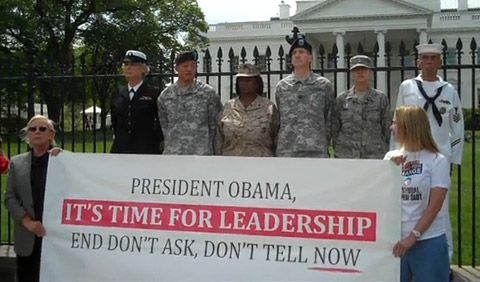
Thanks go to Andy Towle, who posted an article and informative pics about the GetEqual protest today in Lafayette Park. Six servicemen handcuffed themselves to the White House fence today in protest of the "Don't Ask, Don't Tell" policy within the U.S. military. Police quickly ushered the press and passersby away from the White House lawn and closed down Lafayette Park in response to the incident.
Press called the police response "outrageous and ridiculous".
Among the protesters was Lt. Dan Choi, quoted as saying: “We are handcuffing ourselves to the White House gates once again to demand that President Obama show leadership on repealing ‘Don’t Ask, Don’t Tell.’ If the President were serious about keeping his promise to repeal this year, he would put the repeal language in his Defense Authorization budget. The President gave us an order at the Human Rights Campaign dinner to keep pressure on him and we will continue to return to the White House, in larger numbers, until the President keeps his promise to repeal ‘Don’t Ask, Don’t Tell’ this year.”
The protest in question follows an incident yesterday at the recent DNC fundraiser, where LGBT supporters interrupted the President. LGBT activists and supporters have growing concern over whether "Don't Ask, Don't Tell" will be repealed before the next Congressional election.
The GetEqual website has this to say:
"Our hopes swelled when President Obama promised to end Don't Ask, Don't Tell (DADT). But his words mean nothing without action. And he has an opportunity to take action right now, by placing repeal language in the Defense Authorization Bill (DAB), which provides funding for all military operations. But recent reports suggest that the Administration is trying to delay any law change until December or even later."
Wednesday, April 14, 2010
Dog Days of Spring, Illinois-style.
The ides of April are here, and like most springs in Illinois, it has interrupted the slow, gradual quickening of the earth. I planted a garden, and my strawberries are already blossoming. Last week I planted garlic, and the sprouts are already six inches tall. Watermelon radish sprouts I started a week ago (and planted three days ago) have already sprung out of the hard ground that was once a shoddy barren weed patch. My roses have literally exploded with new canes and leaves.
Last year we were certain the garbage-ridden hill we inherited with the house was full of softwood rubbage trees and half-dead lilac bushes. Already, I have a lilac bouquet on my dining room table, and the violets have conquered my hill in anticipation of the weed wars of June and July.
The thermometer has toppled 80 degrees or more for several consecutive days, and all we need now is a few more warm days after a good rain to summon the morel mushrooms I've been impatiently waiting for. One year, I remember mushroom hunting with my cousins at my gramma's house in Bartonville. Excited, but having no luck, I started running around with flowers in hand when I lept out of a hedge of thick grass. I noticed the familiar golden-tan color of Golds at my feet and lept over a ring of about 30 morels. I'd found the trove not thirty feet from the house, in plain sight. The delicious buggers came in all shapes and sizes, some larger than a baby's fist, some smaller than my fingernail.
This year, I intend to freeze or dry them, make morel broth out of them, sautee them in butter and make a wonderful Malbec-marinated filet minon with morels and baby red potatoes... I'm thinking garlic and rosemary are a must. Tomorrow, or by moonlight, some of those conquering violets are going to be picked, dried, and candied for cakes, ice cubes, and tea. Candied violets pair make a welcome addition to fruit soups or flower petal salads. Hopefully, they will also do well with my Black Magic roses.
When my veggie patch fills in, I intend to fill some of the intentional blank spots with Cherokee Purple heirloom tomatoes and kitchen herbs. I have a thistle bush I transplanted on either side of my garden for protection. Thistle is a beautifully unwanted weed with thorns but lovely purple flowers if you give it a chance to speak for itself.
Lucy was hyper this morning, so we took her to the dog park and ran with her for about 20-30 minutes. Mom and I then went to Mr. G's, where I had a yummy Gyro and she had a Coney Island dog on a poppyseed bun. Of course, she had to take me over to Baskin Robbins for a "Baseball Nut" icecream cone. Think vanilla with pomegranate syrup swirl, and add cashews. Damn well compensated for the run I had prior to it.
In other news, I was asked by Jack Stewart at the d20 Girls Project to work at the Chicago Comic and Entertainment Expo (C2E2) this weekend. I'd be promoting the site, doing a convention report, and utilizing my camera. I'm glad to just be doing work in something related to my field of interests (rather than housecleaning for cripplingly low pay and a cosmonaut boss-- if you get my drift). Plus, it speeds up the hiring process for my d20 Girls application and would get me some decent exposure.
I'm off to get some of my own laundry done, then off to ICC to check on my Stafford Loan, and then I have to get ready for my interview.
XOXO--
The Mad Child
Last year we were certain the garbage-ridden hill we inherited with the house was full of softwood rubbage trees and half-dead lilac bushes. Already, I have a lilac bouquet on my dining room table, and the violets have conquered my hill in anticipation of the weed wars of June and July.
The thermometer has toppled 80 degrees or more for several consecutive days, and all we need now is a few more warm days after a good rain to summon the morel mushrooms I've been impatiently waiting for. One year, I remember mushroom hunting with my cousins at my gramma's house in Bartonville. Excited, but having no luck, I started running around with flowers in hand when I lept out of a hedge of thick grass. I noticed the familiar golden-tan color of Golds at my feet and lept over a ring of about 30 morels. I'd found the trove not thirty feet from the house, in plain sight. The delicious buggers came in all shapes and sizes, some larger than a baby's fist, some smaller than my fingernail.
This year, I intend to freeze or dry them, make morel broth out of them, sautee them in butter and make a wonderful Malbec-marinated filet minon with morels and baby red potatoes... I'm thinking garlic and rosemary are a must. Tomorrow, or by moonlight, some of those conquering violets are going to be picked, dried, and candied for cakes, ice cubes, and tea. Candied violets pair make a welcome addition to fruit soups or flower petal salads. Hopefully, they will also do well with my Black Magic roses.
When my veggie patch fills in, I intend to fill some of the intentional blank spots with Cherokee Purple heirloom tomatoes and kitchen herbs. I have a thistle bush I transplanted on either side of my garden for protection. Thistle is a beautifully unwanted weed with thorns but lovely purple flowers if you give it a chance to speak for itself.
Lucy was hyper this morning, so we took her to the dog park and ran with her for about 20-30 minutes. Mom and I then went to Mr. G's, where I had a yummy Gyro and she had a Coney Island dog on a poppyseed bun. Of course, she had to take me over to Baskin Robbins for a "Baseball Nut" icecream cone. Think vanilla with pomegranate syrup swirl, and add cashews. Damn well compensated for the run I had prior to it.
In other news, I was asked by Jack Stewart at the d20 Girls Project to work at the Chicago Comic and Entertainment Expo (C2E2) this weekend. I'd be promoting the site, doing a convention report, and utilizing my camera. I'm glad to just be doing work in something related to my field of interests (rather than housecleaning for cripplingly low pay and a cosmonaut boss-- if you get my drift). Plus, it speeds up the hiring process for my d20 Girls application and would get me some decent exposure.
I'm off to get some of my own laundry done, then off to ICC to check on my Stafford Loan, and then I have to get ready for my interview.
XOXO--
The Mad Child
Tuesday, April 13, 2010
Rude Awakenings
This morning was a rather rude awakening for me. Lately, my live-in boyfriend's alarm wakes me up at 6 and I spend the next hour and a half trying to convince him to get up because I'm the only one stressing out about it. Typically, I'm so tired afterwards that I fall back asleep for another 4 hours (I haven't been sleeping very well lately).
Well, my mother has obsessive go-get-em tendencies that at times leans heavily towards being Meritocratic. This is endlessly frustrating on my bad days, because her shaming me over my depressive habits feed back into the cycle. I told someone the other day, Depression doesn't make me act a certain way, it just takes away most of my choices and tells me that collapsing into myself is the most meaningful option.
Without getting much more off-track, this morning my mother decided to noisily clean the storeroom I've been neglecting. The store room is of course next to my bedroom, therefore it is utterly necessary for her to get after me for being in bed at 9:30 in the morning on her way up, and then again about something else on her way down.
I always feel that arguing with my mother is pointless and bad for one's health, but she is utterly amazing at driving me up the wall. I realize I probably shouldn't have argued, and will probably hug her and apologize when she gets back from the dog park with Lucy.
In any case, my rude awakening this morning was that I'm not fooling anyone, not even myself. I have to get these things done because I want to get them done (and I have). Finding my impetus is an endlessly frustrating struggle, but I guess I have to find one thing that makes me mad to get out of bed every day (yesterday I didn't).
Here are my goals for today: finish laundry and de-skankify my living quarters, put in an application at the print shop down the street, sit and write for at least 2 hours no matter who I have to kill to get it done.
Well, my mother has obsessive go-get-em tendencies that at times leans heavily towards being Meritocratic. This is endlessly frustrating on my bad days, because her shaming me over my depressive habits feed back into the cycle. I told someone the other day, Depression doesn't make me act a certain way, it just takes away most of my choices and tells me that collapsing into myself is the most meaningful option.
Without getting much more off-track, this morning my mother decided to noisily clean the storeroom I've been neglecting. The store room is of course next to my bedroom, therefore it is utterly necessary for her to get after me for being in bed at 9:30 in the morning on her way up, and then again about something else on her way down.
I always feel that arguing with my mother is pointless and bad for one's health, but she is utterly amazing at driving me up the wall. I realize I probably shouldn't have argued, and will probably hug her and apologize when she gets back from the dog park with Lucy.
In any case, my rude awakening this morning was that I'm not fooling anyone, not even myself. I have to get these things done because I want to get them done (and I have). Finding my impetus is an endlessly frustrating struggle, but I guess I have to find one thing that makes me mad to get out of bed every day (yesterday I didn't).
Here are my goals for today: finish laundry and de-skankify my living quarters, put in an application at the print shop down the street, sit and write for at least 2 hours no matter who I have to kill to get it done.
Monday, April 12, 2010
Internet Addiction and Writers Block: Symptoms or Enablers of Depression?
I've spent a lot of time lately within 50 yards on my laptop. After some hard problems in late January, I had to reevaluate my goals, and had to dump some classes and quit my job due to overwhelming stress and depression. But I haven't really been doing anything. I'm horrifically blocked, having a difficult time writing anything at all. It seems rather pointless.
I'm spending a lot of time justifying my internet time, also. I've been saying how much I've been doing to improve my "followers" for "when I get published". It's really rather lame.
I joined the D20 Girls Project, and I'm waiting on an interview. I don't know what's going to come of it, but hopefully I'll at least have some interesting diversions and con time. I've already met a lot of great people there.
I also started posting vlogs on Youtube, but I only have 2 subscribers there (and one follower here). So I'm not sure how that counts. I need to advertise, but have no disposable cash with which to do so.
I tried googling the topics of one of my own blog entries just to see where it would be on the list and it turns out that it's somewhere among the 21,000 other web pages that may or may not be related.
Besides that, I actually have put 3 or so applications (one for the Examiner), but we'll see how that turns out. I added AdSense on this blog here, but I accidentally clicked on one of the ads so they'll probably ban me. I hope not, since it was an accident, but whatever.
It's such a nice day out, but instead I'm chained at the waist to this damn thing, thinking all sorts of bad things, and feeling artistically paralytic.
What the fuck is wrong with me?
I'm spending a lot of time justifying my internet time, also. I've been saying how much I've been doing to improve my "followers" for "when I get published". It's really rather lame.
I joined the D20 Girls Project, and I'm waiting on an interview. I don't know what's going to come of it, but hopefully I'll at least have some interesting diversions and con time. I've already met a lot of great people there.
I also started posting vlogs on Youtube, but I only have 2 subscribers there (and one follower here). So I'm not sure how that counts. I need to advertise, but have no disposable cash with which to do so.
I tried googling the topics of one of my own blog entries just to see where it would be on the list and it turns out that it's somewhere among the 21,000 other web pages that may or may not be related.
Besides that, I actually have put 3 or so applications (one for the Examiner), but we'll see how that turns out. I added AdSense on this blog here, but I accidentally clicked on one of the ads so they'll probably ban me. I hope not, since it was an accident, but whatever.
It's such a nice day out, but instead I'm chained at the waist to this damn thing, thinking all sorts of bad things, and feeling artistically paralytic.
What the fuck is wrong with me?
Guilt-free Quesadillas
Guilt-free Quesadillas
(Vegetarian, Low Sodium, Low Calorie)
I love making healthy food, especially if I can manage to make junk food healthy.
Here's a sort of generic recipe I have that is way good and guilt free. Portions below serve one for lunch, approximately 183 calories.
Find my recipe on my Examiner page.
Meat lovers: the meaty taste of the mushrooms means you will not miss your carnivorous ways. And yes, this recipe is filling. If you aren't counting calories, you could double the amount, but my guess is you won't need to.
The best part about this recipe is that it is cheap, no fuss, and soils few dishes.
Subscribe to:
Posts (Atom)


